
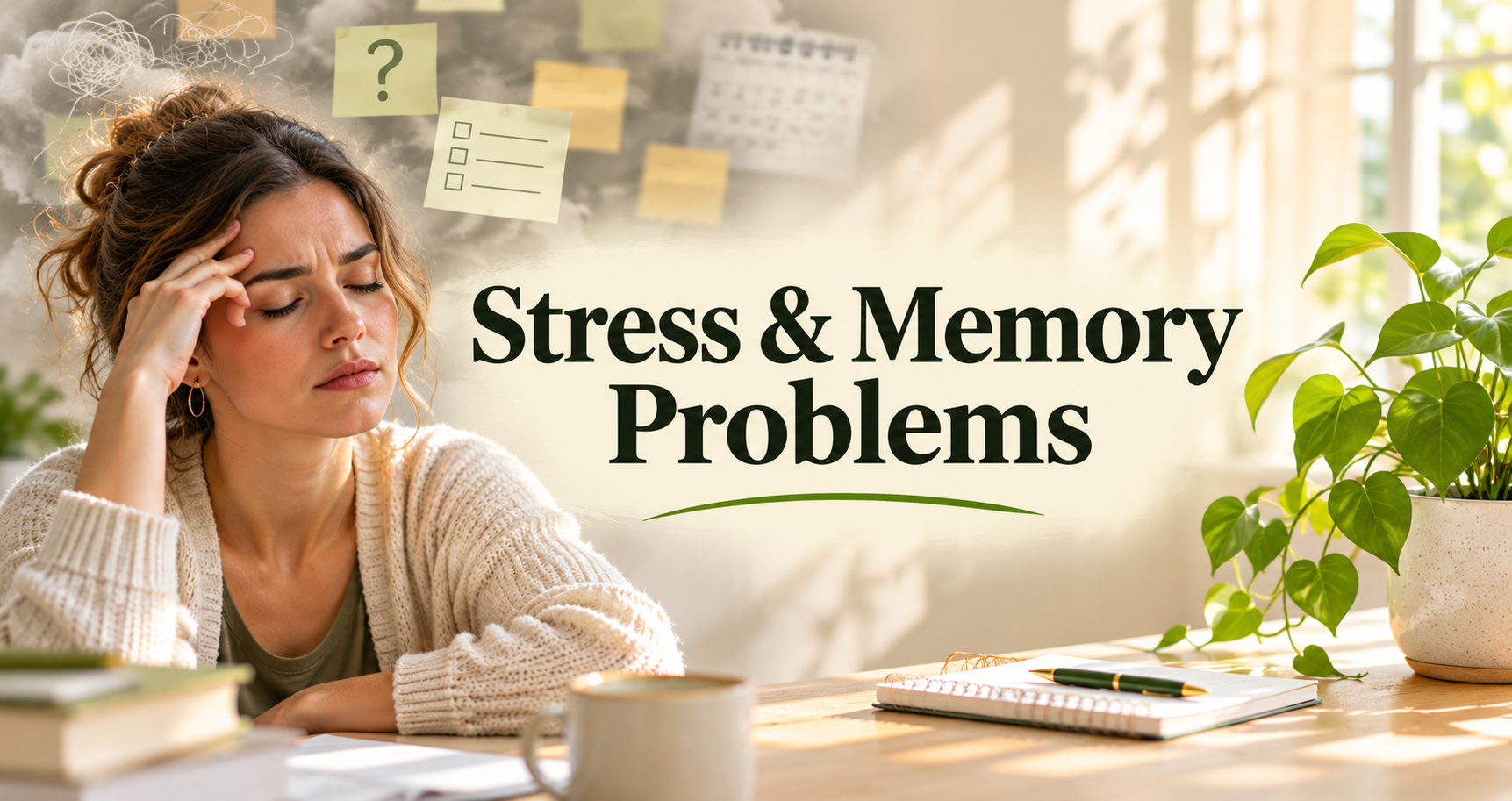
Researchers have one common way to put volunteers under pressure in a lab: ask them to count backward from 1,073 by 13s while someone grades them, a task Harvard Health describes.
Nobody has to be ill for this to work. The pressure alone is enough to change how well people hold and retrieve information.
That is the core of stress and memory problems. If your own life has felt like that testing room for weeks or months, the symptoms are familiar: walking into a room and forgetting why, rereading the same email three times, losing your place mid-sentence.
This guide covers what stress does to memory, what the research does and does not prove, and when forgetfulness deserves a doctor. It also shows where a counselor such as Rhiannon Cruz at Empowering Minds Therapy fits in.
Key Takeaways
- Stress rarely erases memories. It disrupts the steps that make them usable: paying attention, holding information, and pulling it back.
- Stress can weaken memory for plain, practical details while leaving memory for emotionally charged moments intact, which helps explain why a worry replays but a to-do item vanishes.
- In a study of 2,231 adults, higher cortisol went with worse memory scores. That is a link, not proof of cause.
- Forgetfulness that rises and falls with your stress and sleep is a different pattern from steady decline or confusion about familiar people and places. The second one calls for a doctor.
What Is Stress Actually Doing to Your Memory?
Stress rarely deletes memories. It crowds the systems that make memory work: attention, short-term holding, and retrieval. When your brain treats a problem as urgent, it sends resources there and leaves less for learning new details or finding old ones. The result feels like forgetfulness, but the information is often never stored or is simply hard to reach.
Harvard Health explains that stress and anxiety make it harder to concentrate and lock in new information. You can forget something because you were not fully paying attention, not because your memory failed.
Dr. Kerry Ressler, a professor of psychiatry at Harvard Medical School, describes the trade-off as “survival mode, not memory mode.
Hormones add another layer. Cortisol, the main stress hormone in humans, acts on the hippocampus and prefrontal cortex, regions involved in forming memories and in working memory. In a Leiden University study of 20 young healthy men, psychosocial stress impaired working memory at high mental loads, and higher cortisol went with poorer memory retrieval.
Why Do You Remember the Embarrassing Moment but Forget the To-Do List?
Stress does not hit every kind of memory equally.
In a 2009 study at the University of Bern, stressed participants showed a pronounced deficit in working memory, the mental scratch pad that holds a phone number or a set of directions. Memory for negative emotional material held up, and on an implicit-memory test it improved.
Put those findings together and a familiar pattern appears. A stressed mind is good at keeping threats and bad at keeping routine. The meeting you replay at 2 a.m. stays vivid. The errand you promised to run does not.
That changes the question worth asking. “Is my memory failing?” is usually the wrong one. “What is my brain prioritizing right now?” gets you further.
What Does the Research Say About Stress and Memory Problems?
A large community-based study offers a useful anchor. In a 2018 analysis in Neurology, drawn from the Framingham Heart Study, researchers examined 2,231 dementia-free adults with an average age of 48.5. Higher morning blood cortisol went with worse scores on memory and other thinking tests. In women, it also went with lower total brain volume.
Read that with the right level of caution. Cortisol was measured once, and the design shows an association, not proof that stress caused the differences.
Harvard Health adds that the effect of stress on the brain is well documented, but it is less clear which kinds of stress do lasting harm. Long-term stress is generally worse than short-term stress, and three things make it harder on the brain: it is unpredictable, it has no end point, or you lack support. Ongoing money worries are the example Harvard gives for stress with no end in sight.
Is It Stress, or Is It Time to See a Doctor?
Stress-driven forgetfulness is common, but stress and memory loss are not always cause and effect. Mayo Clinic lists stress, anxiety, and depression among emotional causes of forgetfulness, confusion, and trouble concentrating, and it lists other treatable causes too. Use this table as a rough sorting tool, not a diagnosis.
| What you notice | Fits a stress pattern | Worth a doctor’s visit |
| Timing | Worse during deadlines, poor sleep, or emotional strain; better on calmer days | Steady decline, or a sudden change that does not track your stress |
| Type of lapse | Missed details, blanks on names or words, a lost train of thought | Confusion about time, people, or familiar places |
| Daily life | You notice the slips and can work around them | Trouble with routine tasks, self-care, or safety |
| Other signs | Tension, restless sleep, irritability, racing thoughts | A recent head injury, a new medication, or others pointing out changes |
If the right-hand column sounds familiar, book a medical checkup first. Counseling can run alongside that care, not in place of it. The National Institute on Aging also advises talking with a doctor about memory changes that worry you.
The 3-Leak Check: Where Is Stress Costing You Memory?
Stress and memory problems usually show up at one of three leak points, and each needs a different fix.
- Leak 1, intake. You never fully registered the information, so it was not stored. Sign: you cannot recall what someone said five minutes ago. Fix: pause for ten seconds and repeat the detail back.
- Leak 2, holding. Too many open items overload working memory, so a task slips before you act on it. Sign: you walk to another room and lose the reason. Fix: move the item onto paper or a phone note.
- Leak 3, retrieval. The information is stored, but pressure blocks access. Sign: a name sits on the tip of your tongue and drifts further away as you push. Fix: stop forcing it, breathe out slowly, and return in a minute or two.
Match the leak to the fix. Treating all forgetfulness as one problem is how people end up playing memory games when the real fix is a notes app and an earlier bedtime.
How Do You Protect Your Memory When Your Mind Is Overloaded?
Six habits, in the order most people find easiest to start:
- Capture it the moment you hear it. Choose one place, one notes app or one notebook, and write the task before you do anything else. Two systems leak.
- Say key details back out loud. When someone gives you a time, name, or instruction, repeat it in a full sentence. That rebuilds the attention stress scatters.
- Give daily items fixed homes. Keys, wallet, and phone go in the same spot every time. For unpredictable stress, Harvard Health advises controlling what you can, and routine is the easiest place to start.
- Run a five-minute brain dump before you stop work. List every open task, worry, and decision so you stop carrying twenty open loops into the evening. This is a practical habit, not a clinical treatment.
- Protect sleep like an appointment. Dr. Ressler notes that sleep deprivation makes the brain regions handling higher-order functions work less well. Set a steady wake-up time and a point in the evening when work stops.
- Interrupt the blank. When your mind empties, pause the search, exhale a few times slowly, and come back to the question afterward.
More routines like these live in the self-care strategies section of the Empowering Minds Therapy website.
What Most People Get Wrong About Stress and Memory Problems
Five habits keep stress-related forgetfulness going longer than it needs to.
- Mistake: calling it a “bad memory.” Do this: for two weeks, note when lapses happen and what else was going on, such as poor sleep, heavy workload, or conflict. Not that: decide your brain is permanently broken.
- Mistake: pushing harder to recall. Do this: step away and let it surface. Not that: repeat the failed search until frustration spikes.
- Mistake: trading sleep for hours. Do this: protect sleep first and fit tasks around it. Not that: run on a deficit and rely on willpower.
- Mistake: assuming it is always stressful. Do this: get a medical check if the right-hand column of the table fits. Not that: diagnose yourself from search results at midnight.
- Mistake: waiting for the pressure to end on its own. Harvard Health notes that stress without an end point is harder to cope with, and that earlier help may reduce stress-related problems later. Do this: ask for support while the load is still manageable. Not that: hold out for a calm stretch that never arrives.
When Is It Time to Talk to a Counselor?
Habits fix the leaks you can see. They do less when the source of the stress is still running: an anxiety pattern that will not switch off, a loss that has not settled, a strained relationship, or the aftermath of something painful.
That is where counseling fits. Rhiannon Cruz, MS, LPC, is a Licensed Professional Counselor in Arizona and the counselor behind Empowering Minds Therapy. Her anxiety counseling centers on identifying triggers, building coping strategies, and developing practical tools to reduce anxious thoughts. Her practice also covers trauma, grief, and depression, all common sources of long-running stress.
Sessions are offered by video, phone, or secure chat, and goals and a treatment plan are set together with you. You can learn more on the about page.
One honest boundary: counseling addresses the stress side of the equation. It is not a medical workup for memory loss, so if the comparison table raised concerns, see a doctor first.
The Bottom Line
Stress and memory problems are closely linked, but the link is not a life sentence. Your brain has not stopped working. It has shifted its priorities toward whatever feels urgent.
That gives you somewhere to start. Find the leak that costs you most, fix that one first, protect your sleep, and get what is in your head onto paper.
If the load is bigger than habits can carry, that is a reason to ask for support, not a verdict on your intelligence.
Which leak is yours? Pick one fix from this guide and run it for the next seven days. If you would rather not do it alone, Empowering Minds Therapy is a call or a click away.
Frequently Asked Questions
Is memory loss from stress permanent, and how long does recovery take?
Usually not, though research has not pinned down which kinds of stress cause lasting changes. Forgetfulness tied to stress, anxiety, or low mood is generally described as temporary and tends to ease as those feelings do. No one can promise a timeline, so see a doctor if recall does not improve or gets worse.
Can stress affect memory in your 20s and 30s?
Yes, age does not shield you. Laboratory studies have found working-memory effects of stress in healthy young men, and the Framingham analysis linked higher cortisol to worse memory scores in adults averaging 48.5 years old. If you notice lapses at any age, track your sleep and workload alongside them.
Does anxiety cause memory problems too?
Yes, anxiety is a recognized cause of forgetfulness and trouble concentrating. Mayo Clinic lists stress, anxiety, and depression among emotional conditions that can disrupt memory and focus. Worry occupies the same mental bandwidth you need to take in new information, which is why the two so often arrive together.
What is brain fog, and is it the same as memory loss?
Not exactly. Brain fog is an everyday term for slow, unfocused thinking rather than a medical diagnosis, while memory loss means trouble storing or recalling information. The two overlap, and stress, poor sleep, and anxiety can cause both. If the fog does not lift, mention it to a doctor.
Which medical conditions can look like stress-related memory loss?
Several treatable conditions can mimic it, including thyroid problems, vitamin deficiencies, sleep apnea, depression, and medication side effects. Mayo Clinic and the National Institute on Aging both list causes like these. A doctor can check for them, which is why a medical checkup is worth booking before you assume stress is the only cause.
Can poor sleep make stress and memory problems worse?
Yes. Stress can disrupt sleep, and Harvard Health notes that sleep deprivation makes the brain regions handling higher-order functions work less well. That sets up a loop: stress costs you sleep, and missing sleep makes both the stress and the forgetfulness harder to manage.
What should I do when my mind goes blank?
Stop searching, breathe out slowly, and give it a minute or two. Forcing recall under pressure rarely helps, so turn to something simple, like jotting down what you do remember about the topic, then return to it. If blanks keep happening, note when they occur and what else is going on.
Can therapy help with forgetfulness caused by stress?
Therapy can help when stress or anxiety is driving the forgetfulness, because it works on the source: triggers, coping habits, and anxious thinking. It is not a medical evaluation of memory loss. A sensible plan is both: see a doctor to rule out other causes, and see a counselor to address the stress.
Does Empowering Minds Therapy offer virtual sessions?
Yes. Rhiannon Cruz, MS, LPC, a Licensed Professional Counselor in Arizona, offers sessions by video, phone, or secure chat. Appointments are by request and available mornings, afternoons, evenings, and weekends, so you can fit a session around work and family from wherever you feel comfortable.
How do I book a session at Empowering Minds Therapy?
Call 602-834-8551 or fill out the booking form on the Book Now page of the Empowering Minds Therapy website. Rhiannon will follow up to confirm your appointment. If you are not sure where to start, describe what you have been noticing and ask what a first session would involve.